
Board games
A board gamer since 2021.
The modern board game
Nothing to do with Monopoly. Since Catan appeared in 1995, this has been a hobby with thousands of new titles a year and a vocabulary of its own.
The big family is the euros: management games where you administer resources, luck counts for little and you almost never attack anyone head-on. They are sorted by weight, meaning what they cost to learn and to play: a mid-weight euro is explained in ten minutes and fills a good hour, and a heavy euro asks for a whole afternoon and a clear head. Facing them are the thematic games, which put story and conflict first and have no qualms about rolling dice.
Then there are the formats: a filler is twenty minutes to open or close a session, a party game is for ten people who do not know each other, and co-ops put the whole table on the same side, against the game. All of it is catalogued on BoardGameGeek, where the community itself votes on the weight of each title on a scale of 1 to 5.
What an 18xx is
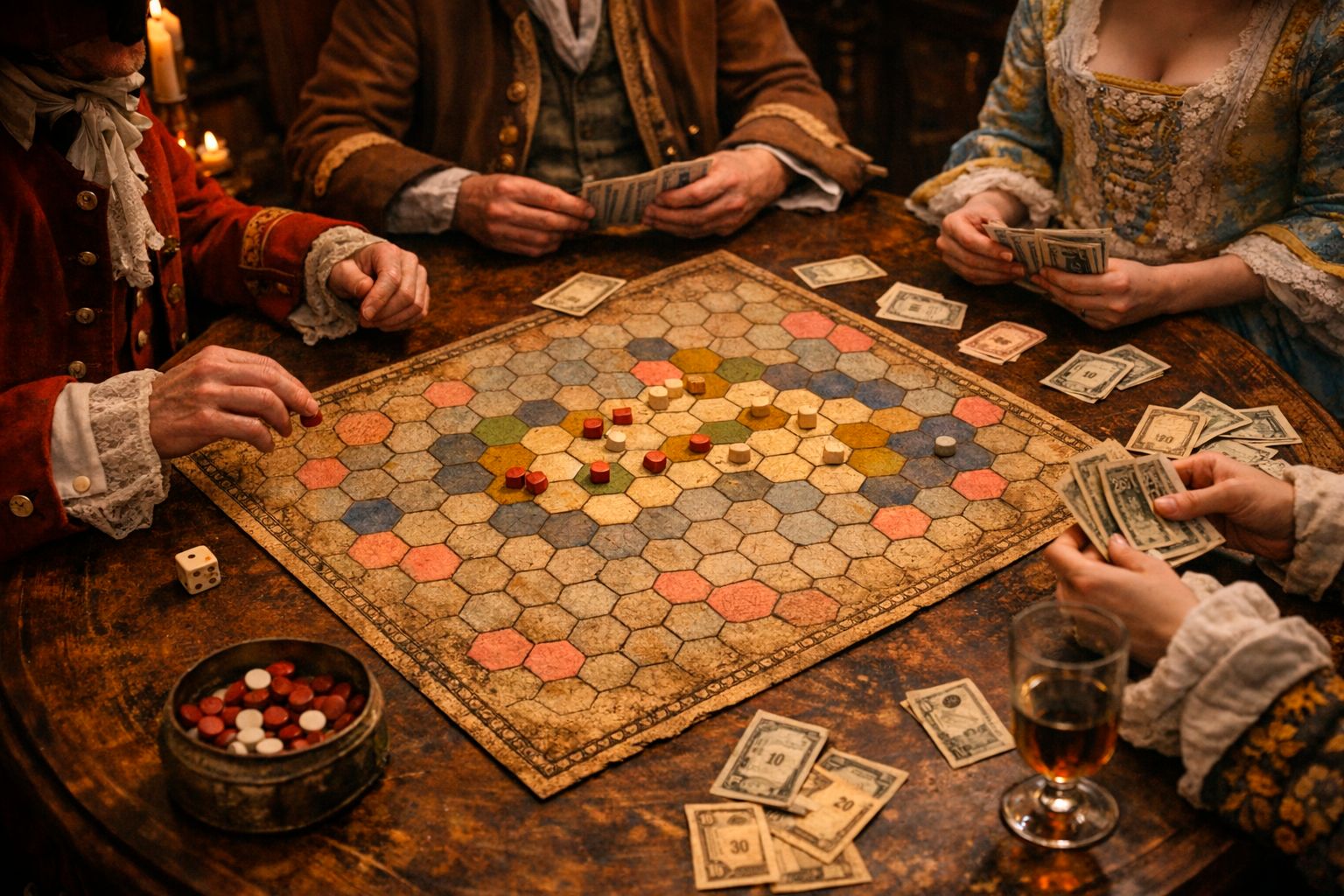
A family of games that starts with 1829, published by Francis Tresham in 1974, and that is about two things at once: laying railway and speculating on its shares.
In an 18xx you are not a company: you are an investor. You buy shares and, if you end up the largest shareholder in one, you get to run it: lay track, buy trains and send them along a route that pays. What the company pays out moves its share price, and that is where the game is won or lost.
There is no hidden information and no luck to rescue you: everything is on the table and every number can be checked. And trains go obsolete, so today's money is the problem you will have three turns from now. Designing one means tuning the map, the companies, the market and that obsolescence until the hard decisions come up on their own.
Mine start from real railway episodes rather than a setting laid on top: the map and the companies are the ones that existed.
What crokinole is
A Canadian dexterity game: a round wooden board and discs you send off with a flick of the finger.
It is played one against one or in pairs. Each disc is flicked towards the hole in the middle, which is worth twenty, and you must hit an opponent's disc if there is one on the board. You learn it in two minutes and never quite master it.
The oldest surviving board is dated 1876: Eckhardt Wettlaufer made it in Perth County, Ontario, as a present for his son's fifth birthday. The world championship is now played every year in Tavistock, Wettlaufer's own village.
In Terrassa there is an open table once a month. You do not need to know how to play, or to bring anything.
Where I play
Besides the community meet-ups, these three clubs run games regularly. Write to them and join a table.